

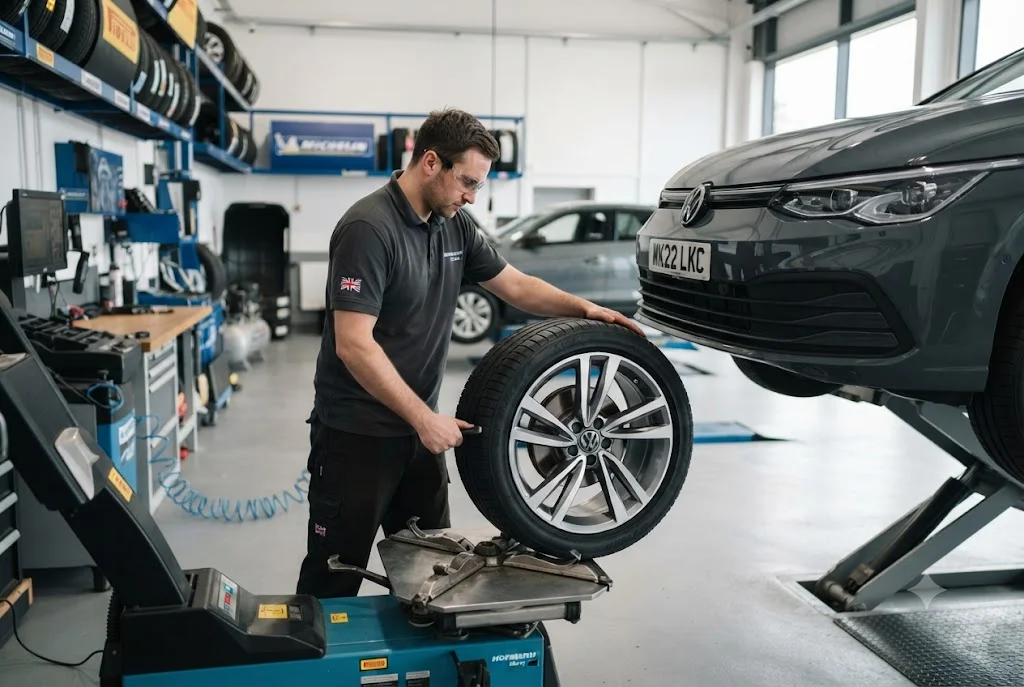
Tyre services cover some of the most important routine requirements for keeping a car safe and roadworthy. From replacing worn tyres and repairing suitable punctures to balancing wheels and fitting new tyre valves, the right service can help maintain grip, handling and braking performance.
UK drivers can choose from traditional tyre centres, independent garages and mobile tyre fitting services, depending on the work required. Understanding what each service involves makes it easier to identify when professional attention is needed and choose the right option for your vehicle.
What Do Tyre Services Include?
Tyre services cover a broad range of work involving tyres and wheels. The appropriate service depends on the condition of the tyre, the vehicle and the problem being experienced.
Common services include:
- Tyre fitting
- Tyre repairs
- Tyre replacement
- Wheel balancing
- Tyre valve replacement
- Tyre pressure checks
- Tread and condition inspections
- Puncture assessment
- Mobile tyre fitting
- Wheel and tyre inspections
A professional technician can determine whether a damaged tyre is suitable for repair or whether replacement is the safer option. Not every puncture or damaged tyre can be repaired.
Why Regular Tyre Checks Matter
Tyres are the only parts of the vehicle that maintain direct contact with the road, making their condition particularly important. Correct inflation, adequate tread and good overall condition can all contribute to safe handling.
Drivers should regularly look for obvious damage and check tyre pressures according to the vehicle manufacturer’s recommendations. Changes in handling, vibration or unusual tread wear can also indicate that an inspection is needed.
UK drivers should remember that tyres must meet the applicable legal requirements for tread depth and condition. GOV.UK provides official information about checking tyre condition and the minimum legal tread depth for cars and other vehicles.
Tyre Fitting: What Does It Involve?
Tyre fitting is the process of removing an existing tyre from a wheel and installing a replacement tyre. Professional fitting requires appropriate equipment because incorrectly fitted tyres can affect safety and vehicle performance.
During a typical fitting service, the technician may:
- Remove the wheel from the vehicle where required
- Remove the existing tyre from the wheel
- Inspect the wheel and tyre seating area
- Fit the replacement tyre
- Inflate the tyre to the appropriate pressure
- Balance the wheel and tyre assembly where required
- Refit the wheel and tighten the wheel fasteners correctly
Tyre fitting should be carried out by a competent professional using suitable equipment. The replacement tyre must also be compatible with the vehicle and appropriate for the wheel size and specification.
When Do You Need Tyre Replacement?
Tyre replacement may be necessary when a tyre is worn beyond the legal limit, damaged beyond repair or showing signs of deterioration that make continued use inappropriate.
Drivers should not rely solely on tread depth. Tyres can also develop cuts, bulges, cracks or other damage that requires professional assessment.
Replacement may be appropriate when:
- The tread has reached the applicable legal limit
- The tyre has significant damage
- A puncture cannot be safely repaired
- The sidewall is damaged
- The tyre has developed a serious bulge
- There are signs of significant deterioration
- The tyre specification is unsuitable for the vehicle
If you are replacing tyres because of uneven wear, it is also worth investigating the cause. A steering, suspension or wheel alignment problem could cause a replacement tyre to wear unevenly again.
Tyre Repairs and Punctures
Tyre repairs can sometimes provide a practical solution for certain types of puncture. However, whether a tyre can be repaired depends on factors such as the location and size of the damage, the tyre’s condition and whether it has been driven while significantly deflated.
Professional inspection is therefore important. A puncture should not automatically be treated as repairable simply because the hole appears small.
Sidewall damage is particularly important because the sidewall performs a critical structural role. A technician may recommend replacement rather than repair where the damage is unsuitable for safe repair.
If a tyre has lost pressure unexpectedly, drivers should avoid continuing to drive on it unnecessarily. Driving on an under-inflated or damaged tyre can cause additional damage and create a safety risk.
How Tyre Balancing Works
Tyre balancing helps correct uneven weight distribution in the wheel and tyre assembly. Even a small imbalance can contribute to vibration, particularly as vehicle speed increases.
During balancing, a technician uses specialist equipment to identify where weight needs to be added or adjusted around the wheel. The aim is to create a more evenly balanced rotating assembly.
Wheel balancing may be recommended when fitting new tyres, after certain wheel or tyre work, or when a driver experiences vibration that could be related to imbalance.
It is important to distinguish balancing from alignment. Balancing addresses weight distribution, while alignment concerns the position and angles of the wheels. A vehicle can therefore require one service without needing the other.
Tyre Valves and Why They Matter
Tyre valves are small components, but they play an important role in maintaining tyre pressure. A damaged or leaking valve can contribute to gradual pressure loss.
When fitting new tyres, technicians may recommend replacing the valves where appropriate. This can be particularly sensible because an old valve may not provide the same reliability as a new component.
Vehicles equipped with tyre pressure monitoring systems may require compatible valve and sensor components. The correct procedure depends on the vehicle’s system, so replacement should be handled by a suitable technician.
Understanding Tyre Pressure
Correct tyre pressure supports handling, braking and tyre wear. The recommended pressure is normally provided by the vehicle manufacturer and may vary according to load or driving conditions.
Drivers should check pressures when the tyres are cold and use an accurate gauge or suitable checking equipment. The pressure shown on the tyre sidewall is not necessarily the recommended operating pressure for the vehicle; it relates to the tyre’s specification and maximum pressure information.
Incorrect pressure can affect how a tyre contacts the road. Under-inflation can also contribute to increased rolling resistance and uneven wear.
How to Choose the Right Tyre
Choosing replacement tyres is not simply a matter of selecting the cheapest option that fits the wheel. Drivers should consider the vehicle manufacturer’s requirements, tyre size, load and speed ratings, driving conditions and intended use.
When comparing tyres, check the information printed on the existing tyre and consult the vehicle documentation where necessary. A professional tyre centre can also help confirm suitable options.
Drivers may encounter premium, mid-range and budget tyres at different price points. The most appropriate choice depends on the vehicle and driver’s requirements, but safety-critical components should not be selected on price alone.
What Are Tyre Centres?
Tyre centres specialise in tyre-related work and may offer a wider range of equipment and services than a general workshop. Depending on the business, services can include tyre fitting, balancing, puncture assessment, replacement, valves and wheel-related checks.
When choosing a tyre centre, consider whether it:
- Works with your vehicle type
- Stocks or can order the required tyre size
- Offers professional fitting equipment
- Provides balancing after tyre installation where appropriate
- Can inspect damaged tyres
- Can advise on suitable replacement specifications
- Offers additional wheel or alignment services
A good tyre centre should also explain why a tyre needs replacing rather than simply recommending additional work without explanation.
Mobile Tyre Fitting: When Is It Useful?
Mobile tyre fitting brings tyre-related services to a customer’s chosen location. This can be particularly convenient when a driver cannot easily visit a traditional tyre centre.
Depending on the provider and service area, mobile technicians may offer tyre replacement, fitting and other tyre-related work at a home, workplace or another suitable location.
Mobile fitting can be useful when:
- A tyre needs replacing at home
- A vehicle is parked at a workplace
- The driver has limited time to visit a garage
- A replacement tyre has been arranged in advance
- Access to a conventional tyre centre is inconvenient
However, mobile fitting is not automatically suitable for every situation. If a vehicle has suffered significant damage or is unsafe to drive, the priority should be obtaining appropriate roadside assistance or professional recovery rather than attempting to drive it to a fitting location.
Tyre Services for Electric and Hybrid Cars
Electric and hybrid vehicles require the same fundamental attention to tyre safety as conventional cars. However, their weight, torque delivery and driving characteristics can make appropriate tyre maintenance particularly important.
Electric vehicles can deliver strong torque immediately, while some models are relatively heavy because of their battery systems. Correct tyre pressure, suitable tyre specification and regular inspection therefore remain important.
For electric vehicle owners, our guide to EV servicing covers wider maintenance requirements beyond tyres. Hybrid owners can also learn more about hybrid servicing and the maintenance of electrified vehicles with combustion engines.
Tyre Wear and Wheel Alignment
Uneven tyre wear can be an early indication of an alignment or suspension problem. If one edge of a tyre is wearing significantly faster than the rest of the tread, simply replacing the tyre may not address the underlying cause.
A professional inspection can determine whether the vehicle needs alignment, suspension work, balancing or another repair.
Drivers may particularly want to consider an alignment check after hitting a pothole or kerb, especially if the steering wheel becomes off-centre or the vehicle starts pulling to one side.
Tyres and MOT Requirements
Tyre condition is also relevant to the UK’s MOT system. The MOT test checks tyres for specific safety and legal requirements, but drivers should not treat the annual test as a substitute for routine tyre inspections.
Tyres can deteriorate or become damaged between MOT tests. Regular checks allow drivers to identify problems sooner and maintain the vehicle throughout the year.
Official GOV.UK MOT information provides details about the MOT system and testing requirements.
How Often Should Tyres Be Checked?
There is no single mileage interval that guarantees a tyre will remain in good condition. Tyre wear depends on driving style, mileage, road conditions, vehicle condition, tyre pressure and other factors.
Drivers should make visual checks part of their regular vehicle routine. Pay attention to tread wear, cuts, bulges and changes in pressure.
It is also worth checking tyres before long journeys, particularly if the vehicle will be carrying additional passengers or luggage. Correct pressures should be set according to the manufacturer’s recommendations for the vehicle’s load.
What to Do If Your Tyre Keeps Losing Pressure
A tyre that repeatedly loses pressure should be inspected rather than repeatedly inflated without investigating the cause.
Potential causes can include a puncture, valve problem, wheel damage or another issue affecting the tyre and wheel assembly. A slow leak may not always be obvious from a quick visual inspection.
A professional technician can inspect the tyre, valve and wheel to determine why pressure is being lost. If the tyre is repairable, an appropriate repair may be possible. If it is unsafe to repair, replacement may be necessary.
When Should You Replace More Than One Tyre?
Whether one or multiple tyres should be replaced depends on factors such as tread depth, tyre condition, vehicle drivetrain, tyre specifications and the recommendations of the vehicle or tyre manufacturer.
Replacing tyres in pairs on the same axle can sometimes help maintain more consistent characteristics between the tyres. However, the correct approach depends on the vehicle and situation.
Drivers should also ensure that replacement tyres match the required specification. A professional tyre service provider can advise on the safest suitable arrangement.
Planning Your Tyre Maintenance
Good tyre maintenance does not need to be complicated. Regular pressure checks, visual inspections and prompt attention to unusual wear can help drivers identify problems early.
It is also useful to combine tyre inspections with other routine maintenance. For example, unusual tyre wear discovered during a service could lead to a check of the steering, suspension or alignment system.
Drivers who prefer predictable maintenance costs may also consider structured car service plans, which can help organise scheduled vehicle maintenance alongside individual tyre requirements.
Final Thoughts on Tyre Services
Tyre services play an essential role in maintaining vehicle safety, handling and roadworthiness. Whether you need tyre fitting, a puncture assessment, balancing, replacement or mobile assistance, choosing the right service depends on the condition of the tyre and the needs of your vehicle.
Do not ignore uneven wear, repeated pressure loss, visible damage or changes in handling. These symptoms can indicate a tyre problem or an underlying issue involving wheels, steering, suspension or alignment.
For UK motorists, regular tyre checks and professional maintenance can help prevent avoidable problems. By choosing suitable tyres, maintaining correct pressures and using qualified technicians when repairs or replacement are required, drivers can keep this critical part of their vehicle in good condition.
