

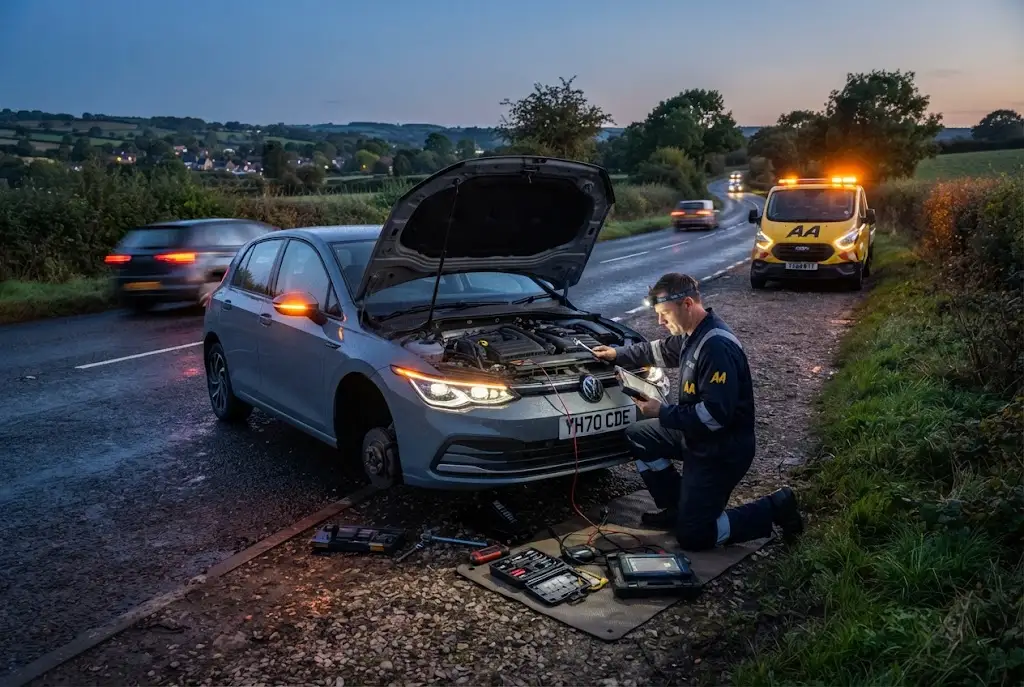
When a vehicle breaks down unexpectedly, emergency vehicle repair can be the difference between getting safely back on the road and being stranded for hours. A flat battery, failed clutch, damaged tyre, engine problem or electrical fault can happen without warning, whether you are commuting, travelling on a motorway or simply leaving home.
Emergency repairs are different from routine servicing because the priority is usually safety, diagnosis and getting the vehicle moving again where practical. Sometimes a roadside repair is possible. In other situations, the safest option is vehicle recovery to a properly equipped garage for further investigation.
What Is Emergency Vehicle Repair?
Emergency vehicle repair refers to urgent mechanical, electrical or related repair work required when a vehicle develops a fault that prevents normal or safe driving. Depending on the problem, the first response may take place at the roadside or at a garage after the vehicle has been recovered.
Common emergency problems include:
- Flat or failed batteries
- Engine starting problems
- Clutch failure
- Brake problems
- Electrical faults
- Overheating
- Tyre or wheel problems
- Warning lights accompanied by serious symptoms
- Damaged components following an impact
- Problems that leave the vehicle unsafe to drive
The correct response depends on the symptoms and the location of the breakdown. A minor fault may be repaired immediately, while a serious mechanical failure can require recovery and workshop repairs.
When Should You Call for Emergency Vehicle Repair?
Not every warning light or unusual noise means that a vehicle has suffered an emergency. However, some symptoms should not be ignored, particularly when continuing to drive could create a safety risk or cause additional damage.
Consider seeking urgent assistance when:
- The vehicle will not start.
- The engine suddenly loses significant power.
- The brakes feel substantially different or stopping performance is reduced.
- The clutch stops operating correctly.
- The vehicle overheats or produces warning signs of excessive temperature.
- Smoke or unusual fumes are present.
- A serious dashboard warning appears alongside unusual vehicle behaviour.
- A tyre or wheel is damaged and the vehicle cannot be driven safely.
- The vehicle has been involved in an accident and may have hidden damage.
If the vehicle is in a dangerous position, such as on a high-speed road, safety should come before attempting to diagnose or repair the problem yourself. The priority should be to get yourself and other road users away from immediate danger and seek appropriate assistance.
What Can a 24 Hour Garage Help With?
A 24 hour garage or emergency repair provider may offer assistance outside normal workshop opening hours. The exact services available vary between providers, so it is important to establish what they can actually handle before arranging assistance.
Depending on the provider, emergency support may include battery assistance, basic roadside diagnosis, minor repairs, tyre-related help, recovery coordination or transport to a workshop.
A 24 hour service does not necessarily mean that every complex repair can be completed immediately. Major engine, transmission, electrical or structural faults may require specialist equipment and more extensive workshop time.
For this reason, ask what is included in the emergency call-out and whether additional recovery or repair charges apply.
How Does Roadside Repair Work?
Roadside repair is intended to resolve a vehicle problem at or near the place where the breakdown occurs, provided the repair can be completed safely and the necessary equipment and parts are available.
A technician may first ask about the symptoms. Information such as whether the engine turns over, whether warning lights appeared, whether the vehicle lost power suddenly and whether unusual noises or smells were noticed can help narrow down the possible causes.
Once at the vehicle, the technician can carry out an initial inspection and diagnosis. Depending on the fault, this may involve visual checks, battery and electrical testing, diagnostic equipment or examination of relevant mechanical components.
A successful roadside repair may allow the vehicle to continue its journey. However, a temporary repair should not automatically be treated as a complete solution. If the technician believes the vehicle requires further workshop attention, recovery may be recommended.
When Do You Need an Emergency Mechanic?
An emergency mechanic can be useful when a vehicle has developed a sudden mechanical problem and ordinary garage opening hours are not practical. The mechanic’s role is to assess the immediate fault and determine whether it can be safely repaired or whether the vehicle needs further attention.
Examples can include:
- Engine starting or running problems
- Clutch-related faults
- Battery and charging problems
- Basic mechanical failures
- Some overheating issues
- Certain electrical faults
- Problems following minor vehicle incidents
However, emergency assistance is not a substitute for a complete workshop diagnosis when the problem is complex. If a vehicle has suffered significant mechanical or structural damage, it may need to be transported to a suitable repair facility.
Emergency Clutch Repair: What Drivers Should Know
Clutch problems can leave a manual vehicle difficult or impossible to drive. Warning signs may include difficulty selecting gears, clutch slipping, unusual noises, a clutch pedal that feels abnormal or a vehicle that fails to transfer engine power correctly.
Clutch repair requirements depend on the underlying fault. In some cases, the issue may involve hydraulic components or another related part. In other cases, the clutch assembly itself may need extensive work or replacement.
Drivers searching for clutch garages should therefore avoid choosing a provider based solely on the advertised price of a clutch replacement. A proper diagnosis should establish what has actually failed before major parts are replaced.
If a clutch has suddenly stopped working, continuing to force the vehicle through gears may make the situation worse. Where safe driving is no longer possible, emergency assistance and recovery are usually more appropriate than attempting to continue the journey.
ABS Repair and ABS Sensor Replacement
The anti-lock braking system is an important vehicle safety system. An ABS warning light does not necessarily mean that the entire braking system has failed, but it should not be ignored.
ABS repair may involve diagnosis of the ABS system, sensors, wiring, control components or other related parts. A diagnostic fault code can provide useful information, but it should generally be treated as a starting point rather than automatic proof that a particular component needs replacing.
ABS sensor replacement may be appropriate if testing confirms that a sensor has failed or been damaged. However, other issues can produce similar symptoms, so proper diagnosis is important.
If the brake pedal feels abnormal, braking performance has significantly deteriorated or another serious braking fault is suspected, do not assume that replacing an ABS sensor will solve the problem. A complete braking-system inspection may be necessary. SmartPress also covers brake repair and braking-system maintenance as a separate service topic.
Headlight Replacement During an Emergency
A failed headlight can become particularly important when driving at night or in poor visibility. Headlight replacement may be a relatively straightforward repair on some vehicles, but modern cars can use more complex lighting systems.
Before replacing a bulb or complete unit, the cause of the failure should be considered. A lighting problem can sometimes involve a fuse, wiring, connector, control system or another electrical component rather than the bulb itself.
Where the issue appears to be part of a wider electrical fault, a specialist inspection may be more appropriate. SmartPress provides a separate guide to auto electrical services, covering vehicle electrical diagnosis and repair.
When Is Vehicle Recovery Necessary?
Some breakdowns cannot be safely resolved at the roadside. Vehicle recovery repairs may therefore begin with transporting the vehicle to a garage where technicians have access to lifting equipment, diagnostic systems, replacement parts and workshop facilities.
Recovery may be appropriate when:
- The engine has suffered a serious mechanical failure.
- The vehicle cannot be started or moved safely.
- There is significant accident damage.
- The brakes or steering cannot be relied upon.
- The clutch or transmission has failed completely.
- The vehicle has substantial overheating or cooling-system problems.
- A roadside technician cannot safely complete the repair.
Trying to drive a vehicle that has a serious mechanical or safety fault can increase the risk of further damage and create danger for the driver and other road users.
Emergency Repairs After an Accident
An accident can create several different repair requirements at once. What looks like simple exterior damage may also involve wheels, suspension, steering, lighting, sensors or other components.
For cosmetic damage such as dents, scratches and damaged panels, a specialist body shop may be required. SmartPress’s guide to car body repairs covers bodywork, accident damage, dent repair and paintwork in greater detail.
After a more serious collision, the priority is to establish whether the vehicle is safe to move. If there is uncertainty about its condition, recovery is generally preferable to driving it away from the scene.
Insurance procedures may also apply following an accident. GOV.UK advises motorists to report an accident to their insurer even when they do not intend to make a claim, subject to the circumstances and policy requirements.
Can a Flat Battery Be an Emergency?
A flat battery is one of the more common reasons a vehicle may fail to start unexpectedly. It can happen because of an ageing battery, extended periods of inactivity, short journeys, electrical faults or leaving lights and other equipment operating when the engine is switched off.
An emergency technician may be able to test the battery and charging system and, where appropriate, provide assistance to get the vehicle started.
However, jump-starting a vehicle does not necessarily fix the underlying problem. If the battery repeatedly loses charge, the charging system or another electrical fault may need investigation.
SmartPress’s auto battery service guide covers battery testing, replacement and related diagnostic considerations.
Emergency Engine Problems
Engine problems can range from relatively minor faults to failures that make continued driving unsafe or potentially damaging. Symptoms such as sudden power loss, severe knocking, excessive smoke, overheating or a major warning light should be treated seriously.
Engine replacement is a major repair and should not normally be recommended without establishing the underlying cause and condition of the engine. Depending on the fault, repair, component replacement or another solution may be more appropriate than replacing the complete engine.
A proper diagnostic assessment can help distinguish between a serious internal engine problem and an issue involving sensors, ignition, fuel delivery, cooling, electrical systems or another component.
SmartPress’s auto tune up service and diagnostic guide explains how professional vehicle diagnostics can help identify engine-related faults.
How Much Does Emergency Vehicle Repair Cost?
The cost of emergency vehicle repair varies significantly because urgent breakdowns can involve very different faults. A simple battery-related call-out can have a completely different cost from an engine failure requiring recovery and major workshop repairs.
Factors that can affect the final cost include:
- Time and location of the call-out
- Whether the service operates outside normal hours
- Diagnostic time
- Parts required
- Labour charges
- Recovery distance
- Vehicle make and model
- Complexity of the underlying fault
- Whether additional workshop repairs are required
Before authorising major work, ask whether the initial call-out, diagnosis, parts, labour and recovery are included in the quoted price. If the vehicle needs to be transported to a workshop, confirm whether recovery is charged separately.
How to Choose an Emergency Repair Provider
When choosing emergency assistance, consider more than how quickly someone can arrive. The provider should have the appropriate equipment and experience for the type of vehicle and fault involved.
Useful questions include:
- Do you provide 24-hour roadside assistance?
- What types of faults can you repair at the roadside?
- Can you carry out vehicle diagnostics?
- Do you provide vehicle recovery if the repair cannot be completed?
- Are parts and labour charged separately?
- Will you explain the fault before major repairs are authorised?
- Can you repair the vehicle at your workshop if roadside repair is not possible?
Clear communication is especially important during an emergency because drivers may have limited alternatives and may be under pressure to get back on the road.
What to Do Before Help Arrives
If your vehicle breaks down, move to a safe location if you can do so without creating additional danger. On high-speed roads, follow the relevant road-safety guidance and avoid standing in an unsafe position around moving traffic.
When contacting a recovery or emergency repair provider, give accurate information about your location and explain the symptoms as clearly as possible. Tell them whether the vehicle can move, whether warning lights are showing and whether there is smoke, leaking fluid or other obvious damage.
This information can help the provider determine what equipment or recovery vehicle may be needed.
Final Thoughts on Emergency Vehicle Repair
Emergency vehicle repair is about more than getting a broken-down car moving again. The immediate priorities are safety, accurate diagnosis and deciding whether the vehicle can be repaired safely at the roadside or needs professional recovery.
Problems involving batteries, clutches, brakes, ABS systems, headlights, engines and electrical components can have very different causes. A qualified technician should therefore diagnose the fault before recommending major parts replacement whenever practical.
For UK drivers, having access to a reliable emergency repair and recovery provider can provide valuable support when an unexpected breakdown occurs. At the same time, regular maintenance can help identify developing problems before they become emergencies.
If the vehicle requires more extensive work, the right specialist should be chosen for the problem. Mechanical faults may require a garage, electrical problems may require an auto electrician, while collision-related bodywork may need a dedicated body repair facility.
